
Cabarrus Parole and Probation Compared
North Carolina Community Supervision manages probation, parole, and post-release supervision. Each status can place a person in the community under rules enforced by the state, but each begins for a different legal reason. Probation is a court-ordered sentence or part of one. Parole is an early prison release mechanism that now applies mainly to offenses committed before Structured Sentencing began. Post-release supervision is the modern period that follows prison for many felony sentences.
A person released from the Cabarrus County Detention Center is not automatically on any of these forms of supervision. Bond, dismissal, time served, and transfer are different events. A person leaving an NCDAC prison may have active post-release supervision even when the prison status is inactive. The two status lines on the NCDAC Offender Search help separate those facts.
| Status | How it begins | Useful public check |
|---|---|---|
| Probation | A court orders supervision instead of, or along with, other punishment. | Read the NCDAC community status and the Cabarrus court case. |
| Parole | The Parole Commission authorizes release under an older sentencing framework. | Read NCDAC status, sentence dates, and Commission review results when applicable. |
| Post-release supervision | A person leaves state prison but continues a required period of community supervision. | Compare Inmate Status with Probation/Parole/Post Release Status. |
- Discharge
- The end of the applicable custody or supervision obligation.
- Absconder
- A person reported as having stopped complying with supervision contact requirements.
- Detainer
- A request or hold from another authority that can affect custody or release.
- Revocation
- A formal action that can end community placement and return a person to custody.
Verify Cabarrus Post-Release Supervision
Use a seven-digit NCDAC offender number when available because it remains tied to the state record after release and on a later return. A Cabarrus jail booking number is different. If only a name is known, use the sounds-like option and a small number of identity filters. Too many filters can hide a record with a spelling or birth-date variation.
- Open NCDAC Offender Search and select Active Probationer/Parolee. Use All if the state is uncertain.
- Match the full name, offender number, age, and other identifiers. Do not select a record solely because the name matches.
- Read both Inmate Status and Probation/Parole/Post Release Status. An inactive prison status can appear beside active community supervision.
- Review the most recent incarceration and latest sentence row. Older actual release dates describe older episodes.
- Use the official Community Supervision directory for routing. Follow only the assigned officer's reporting instructions.
The Cabarrus court file can clarify whether a judge imposed probation, modified it, or entered a revocation order. The Sheriff record answers when a Cabarrus jail episode ended, while NCDAC answers whether state supervision is active. The broader Cabarrus County released-inmate search paths connect those records when custody history is unclear.
Note: A jail release date confirms one custody exit, while an active NCDAC community status confirms that state supervision continues after that exit.
Cabarrus District 19A Supervision
Cabarrus and Rowan counties share Community Supervision Judicial District 19A. The official directory places district management in Landis. That office is a routing contact, not proof that a specific person reports at that address. The public directory does not publish a Cabarrus-only check-in routine, appointment calendar, or general reporting schedule. A supervisee must follow the location, dates, and methods given by the assigned officer.
Community Supervision District 19A
600 South Main Street
Landis, NC 28088
704-855-3883
NC Parole Commission
2020 Yonkers Road
4222 Mail Service Center
Raleigh, NC 27699-4222
919-716-3010
Parole.Commission@dac.nc.gov
At the research date, the district directory named Valerie Washington as Judicial District Manager, with Sylvia Warren and Pamela York as assistants. Staff assignments can change. The NCDAC local-office page and directory should be checked before relying on a name. Public staff can route an inquiry, but confidential officer notes and case plans are not made public merely because an office is contacted.
Cabarrus Parole Review Records
The North Carolina Post-Release Supervision and Parole Commission does not hold a normal calendar of formal prospective hearings or meet personally with offenders to decide parole. Commissioners review files individually, and a majority vote grants or denies parole. A "Next Control Review" field in an offender record concerns custody classification. It is not a parole hearing or predicted release date.
For older parole-eligible cases, the public results equivalent is the Commission's Discretionary Parole Reviews. Monthly retrospective files began in September 2024 and extended through June 2026 when the research was completed. Result terms include Regular Parole, Community Service Parole, Early Medical Release, and 90-Day Mandatory Parole. An Incomplete Decision means more information or an evaluation is needed. It is not a grant.
The official parole process describes the review model and factors such as institutional conduct, program participation, court and victim input, and the proposed release plan. The monthly file and current offender detail must be read together because a review does not itself prove that release occurred.
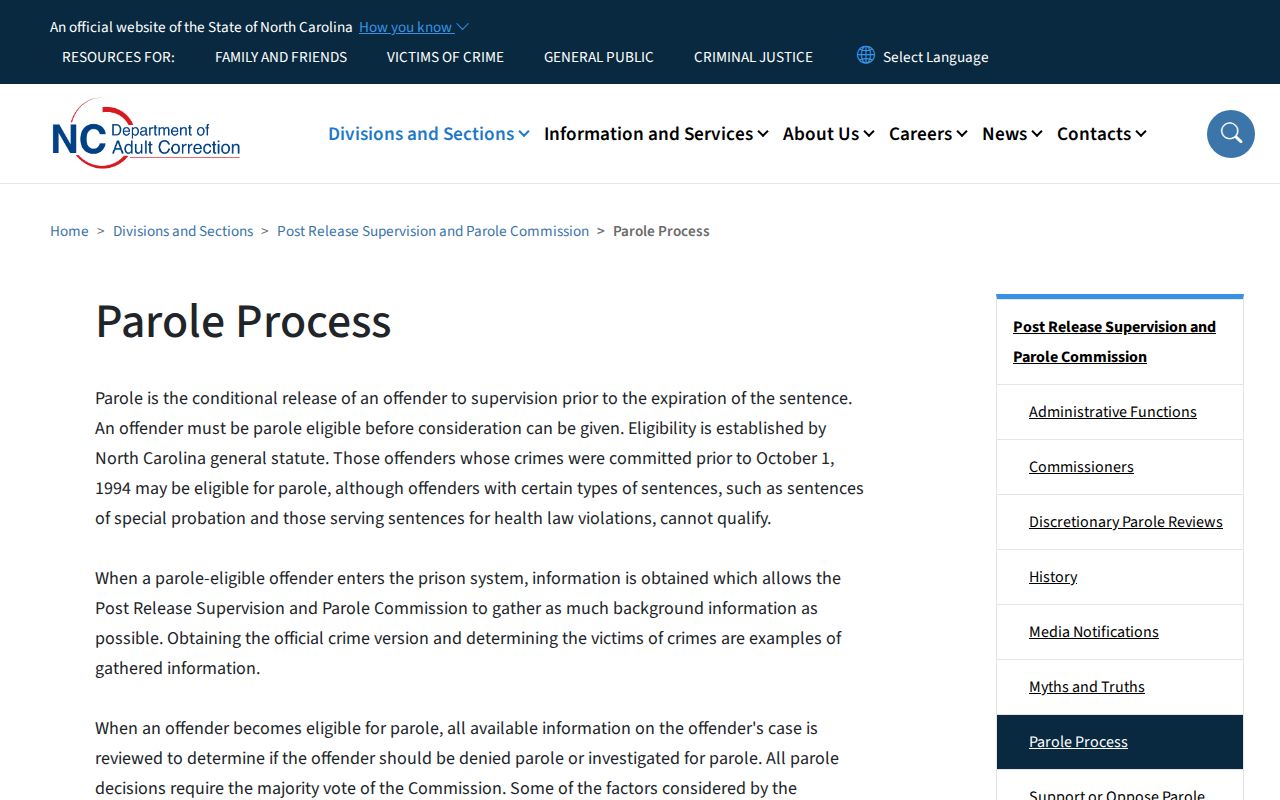
The captured Commission page reinforces that North Carolina parole review differs from a public courtroom-style hearing calendar.
Cabarrus Absconder Status Checks
A person can remain outside prison yet have an unresolved supervision violation. The separate NCDAC Absconder Search is the correct public channel when active supervision and missed reporting are at issue. An absconder result is not a discharge. It signals an unresolved status that should be compared with the main offender detail and confirmed through NCDAC.
Conditions vary by sentence and case. Public pages should not guess at a person's travel, contact, treatment, payment, or reporting terms. Court orders may show probation conditions, and an offender detail may show the broad community status. Under G.S. 15-207, detailed supervision records are confidential. That boundary includes officer notes and case plans that are not part of the general public record.
The official absconder search provides the relevant search screen for Cabarrus County parole and probation verification.
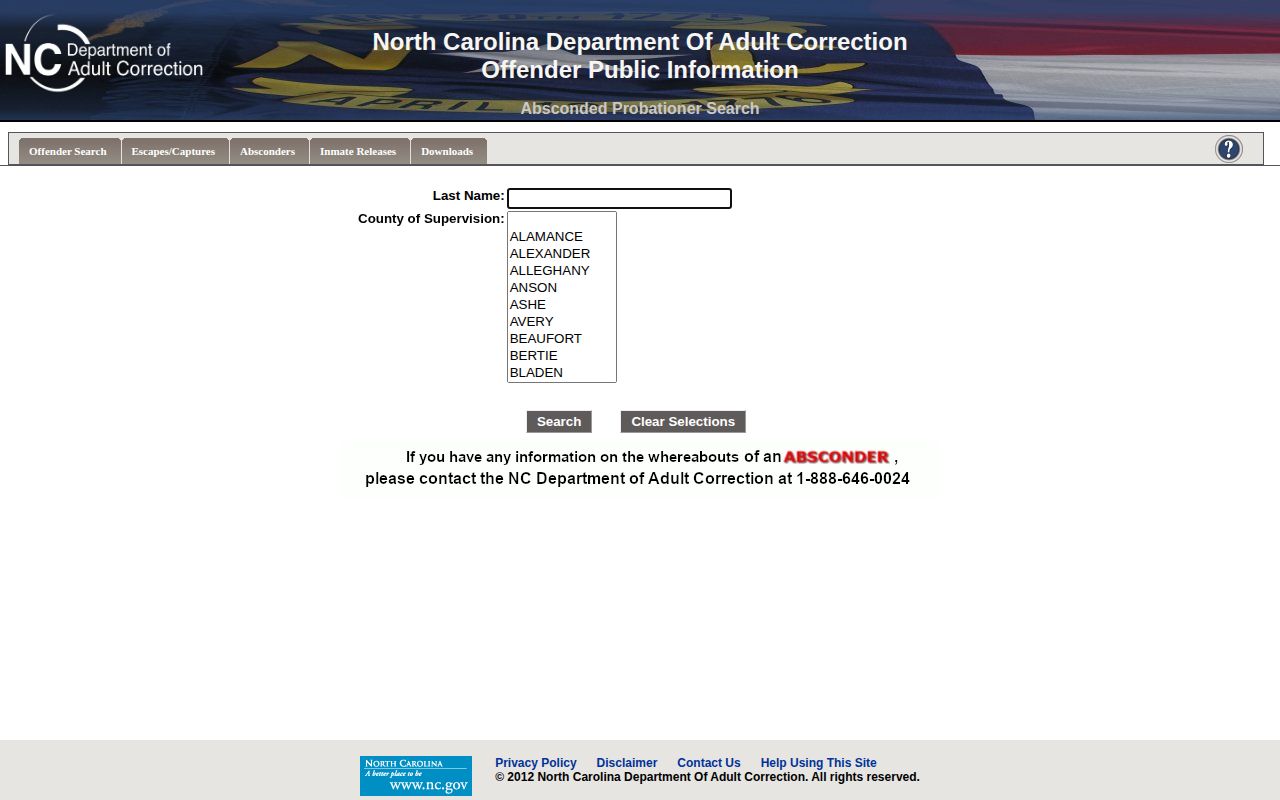
Use a possible match as a prompt to verify the current offender record, not as a substitute for the latest agency status.
Note: NC SAVAN alerts custody events, but it does not replace the NCDAC supervision record or reveal confidential probation and parole case notes.
Cabarrus Supervision and Discharge
Supervision ends through the lawful completion, termination, or other resolution of the applicable term. The public verification rests on the current NCDAC community status and the latest sentence service status. If both prison and Probation/Parole/Post Release Status are inactive, and the relevant latest sentence is expired, the public record no longer reports active state supervision. An inactive status should still be tied to the correct identity and sentence.
Several rows can appear for one person. Each actual release date belongs to that sentence or custody event. A later admission, revocation, or new sentence may follow it. Read the Most Recent Incarceration Summary first, then compare the newest sentence row. For an official record beyond the online display, the NCDAC public-records channel accepts precise requests for public dates and core offender facts. Requests for internal supervision notes may be denied under confidentiality law.
A court order and an agency status answer different questions. The Cabarrus court file can document a probation judgment, modification, or revocation. NCDAC reports the correctional status it administers. If the online record and a signed order appear to conflict, note each date and ask the proper custodian about its own record. Do not treat an older expired sentence as proof that every later term ended.
Cabarrus County Sheriff's Office records remain the source for the physical end of a detention-center episode. NCDAC records cover state prison and community supervision. Neither office should be asked to create a conclusion by combining records it does not maintain.
Cabarrus Reentry After Release
Cabarrus has a local bridge between detention and community services. The Sheriff's Stepping Up program works with Cabarrus Health Alliance on planning for eligible people who have positive mental-health or substance-use screens. County material says two case managers assist with treatment options and basic needs before release, then provide post-release case management.
A separate Sheriff and health-alliance effort supports medication continuity, and county reporting says that work is funded through June 30, 2027. The emerging CORE coalition also focuses on transitions from jail, prison, and community supervision. These programs form a real local reentry network, but eligibility and capacity matter. They should not be read as services promised to every person leaving Cabarrus custody.
Community support does not change legal supervision status. The assigned officer's directions control reporting, while program staff address eligible health and reentry needs. Keeping those roles separate prevents a service contact from being mistaken for a probation or parole check-in.
Cabarrus Supervision Office Routing
District 19A's Landis address is a management and routing point for Cabarrus and Rowan. It is not a published instruction for every Cabarrus supervisee to appear there. Before visiting, use the official directory or call the district number to identify the public contact route. Do not assume that an online district listing overrides a direct instruction from an assigned officer.
The distinction is especially important after a release from state prison. An NCDAC record can show active post-release supervision while the person's reporting site is assigned through internal case routing. The public record confirms broad status. It does not expose a full appointment calendar or private case plan. When an immediate custody alert is needed, NC SAVAN can provide an event notice, but supervision verification remains with NCDAC.
Note: District 19A covers two counties, so the Landis management listing should be used for routing rather than as a universal reporting address.