
Cabarrus Projected Versus Actual Release
A projected release date is a calculation for a sentence that is still being served. An Actual Release Date is a historical field tied to a completed sentence or custody event. That distinction matters in Cabarrus County because an NCDAC detail can contain several sentence rows, admissions, revocations, and old release dates. An actual date on an earlier row does not prove the person is out now. Start with current Inmate Status, the separate Probation/Parole/Post Release Status, and the Most Recent Incarceration Summary. Then connect the date to the newest applicable sentence and its Service Status.
Pretrial custody works differently. A person held at the Cabarrus County Detention Center does not receive an NCDAC prison calculation merely because P2C displays a next court date or bond amount. A court order, posted bond, local sentence completion, or another agency hold can control what happens next. The Clerk record explains the legal action. The Sheriff release record supplies the physical exit time and release code.
Scheduled is not completed. Treat a projected date as a changing plan. Use an Actual Release Date and current status to confirm a finished event.
Find a Cabarrus Release Date
Choose the source by custody type. The statewide NCDAC Offender Search covers North Carolina prisoners and community supervisees, including historical records back to 1972. It does not contain ordinary Cabarrus jail bookings. Civil and Records or the court file is the right route for a local jail episode.
- Identify whether the person is in the Cabarrus jail, an NCDAC prison, federal custody, or another jail. Do not assume the arrest county is the current custodian.
- For NCDAC, search by the seven-digit offender number when known. Otherwise use name, the sounds-like option, age, birth-date ranges, race, and gender carefully.
- Open the correct record and compare Inmate Status with Probation/Parole/Post Release Status. An inactive inmate can still have active community supervision.
- Read the Most Recent Incarceration Summary and explicit Projected Release Date. In sentence history, locate the latest applicable Service Status and Actual Release Date.
- For the Cabarrus jail, compare the court order with the Sheriff booking and release entry. A current P2C record is not a projected-date calculator.
- Save the source, field label, and observation date. Recheck close to the expected event because credits, holds, and court action can change the result.
The NCDAC Inmate Release Search offers a second path for completed state-prison releases. A Cabarrus month query lists people reported as released to Cabarrus County, with release type and date. That county choice is a reported destination. It is not a Cabarrus jail release list.
Cabarrus NCDAC Release Fields
NCDAC separates custody, supervision, and sentence history. Reading just one date invites a false conclusion. The most useful public fields have different roles:
| Field | What it establishes | Reading caution |
|---|---|---|
| Inmate Status | Whether NCDAC reports active prison custody | Inactive does not rule out supervision or a different custodian |
| Probation/Parole/Post Release Status | Whether state community supervision is active | It is separate from prison status |
| Projected Release Date | The current calculated planning date | It can move before release |
| Actual Release Date | A completed event for one sentence row | An older row may not be the latest custody |
| Service Status | Whether that sentence is active, expired, or otherwise recorded | Match it to the correct sentence |
| Next Control Review | A custody-classification review date | It is not a release or parole date |
The sample inactive NCDAC offender detail captured for this project shows why the fields must be read together.
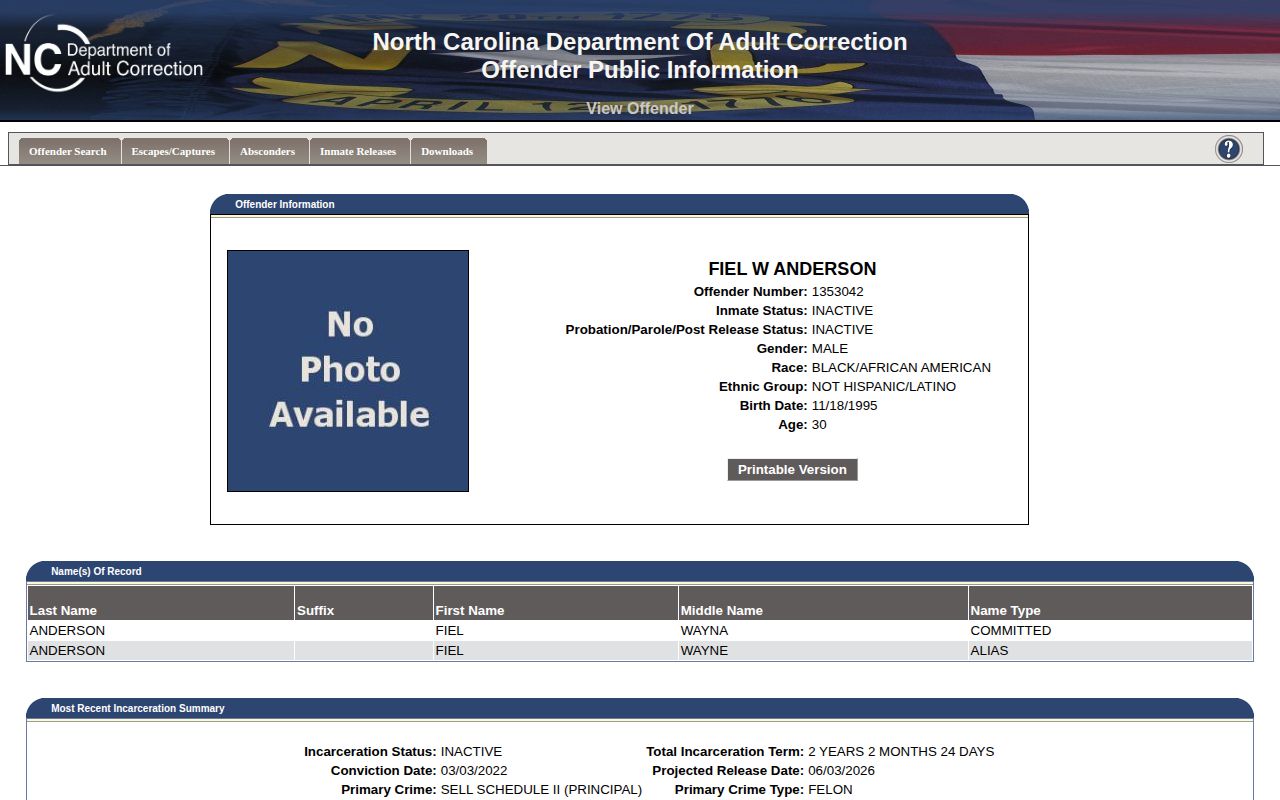
The screen connects the current status with incarceration and sentence rows instead of presenting one universal release date.
North Carolina Earned Release Time
Structured Sentencing applies to offenses committed on or after October 1, 1994. It eliminated parole for those cases. A person must serve the imposed minimum active term, subject to narrow statutory exceptions. Earned-time credit may reduce the maximum toward the minimum, but it does not erase the minimum. That is why the common claim that every person simply receives a 15 percent reduction is wrong.
G.S. 15A-1340.13(d) supplies the minimum-term rule. G.S. 148-13 authorizes credit rules based on conduct, work, study, and program participation. NCDAC explains that structured-sentence credit can move the maximum down but not below the minimum. The sentencing grid, the statutory post-release term, and earned credit work together.
Fair Sentencing cases from July 1, 1981 through September 30, 1994 use a different framework. Gain time, good behavior credit, merit time, disciplinary loss, and older parole rules may apply. The offense date and sentencing law must be identified before any calculation. Mixing those systems can produce a date that looks precise but has no legal value.
Cabarrus Post-Release Date Formula
For many structured felony sentences, leaving prison begins post-release supervision rather than ending every state obligation. G.S. 15A-1368.2 generally sets release to supervision at the maximum term minus twelve months for Class B1 through E felonies or minus nine months for Class F through I felonies, then accounts for earned time. Certain special maximum terms use sixty months. The supervision period is generally twelve or nine months for those class groups, while Article 27A registration offenses can carry five years.
These rules explain why Inmate Status may become inactive while the community-status field remains active. Prison release and supervision discharge are two events. Compliance credits may reduce supervision by no more than twenty percent of its original period. The public record should be read as a sequence: sentence, calculated prison release, actual prison exit, supervision, and eventual discharge.
The NCDAC Victim Support explanation shows how release information is described by the agency.
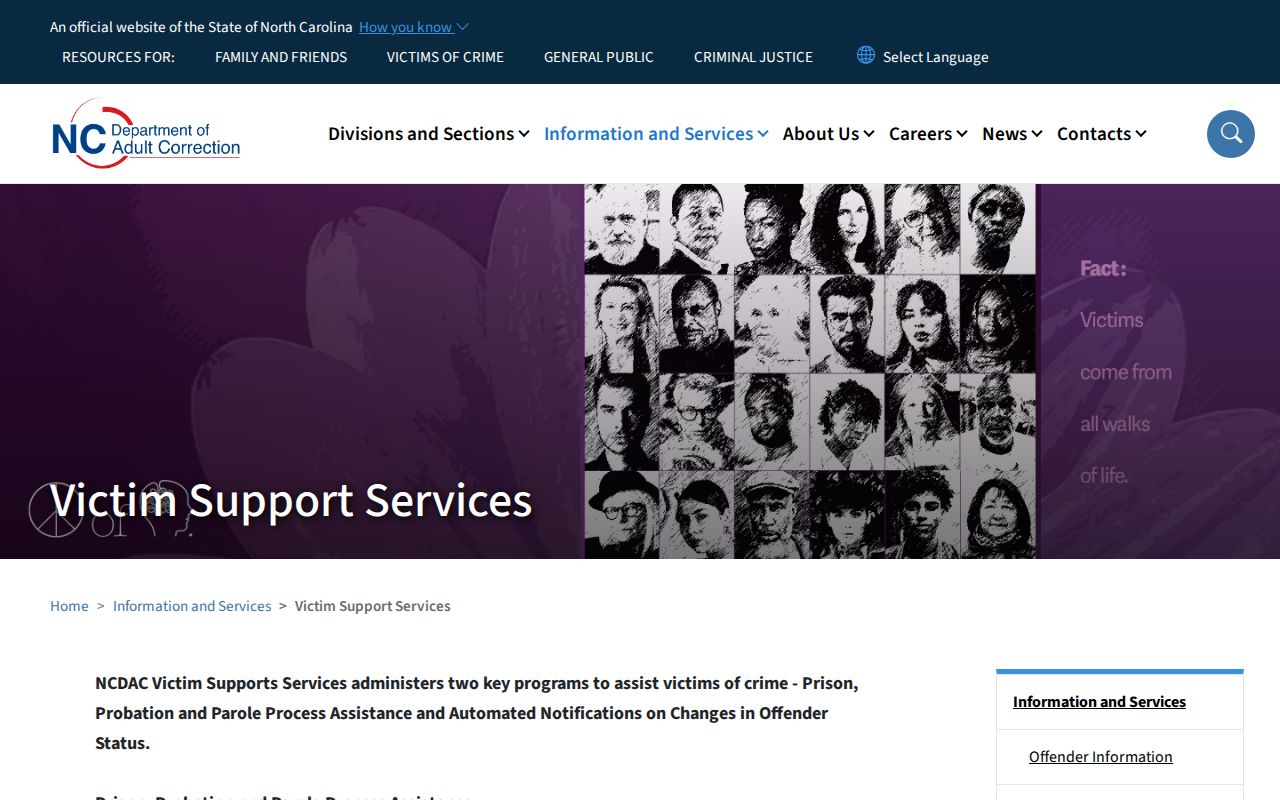
Agency terminology helps separate a forecast from the later actual date and from continuing supervision.
Why Cabarrus Release Dates Move
A displayed date can change for lawful and administrative reasons. Keep the first screenshot only as a dated observation. The later agency record controls the current answer.
| Change | Possible effect | Where to verify |
|---|---|---|
| Earned credit | Moves the maximum toward the required minimum | NCDAC sentence record and release policy |
| Disciplinary loss | Removes credit and may move the date later | NCDAC current calculation |
| Program or work assignment change | Changes the basis for earning future credit | NCDAC record, not an outside estimate |
| Resentencing or vacated sentence | Rebuilds the controlling term | Signed court order and updated NCDAC record |
| Additional sentence or detainer | Can prevent community release after one term ends | Next custodian and court records |
| Release authorization audit | Corrects the date before the event | NCDAC Combined Records |
NCDAC policy generally schedules state-prison releases on weekdays during business hours. A weekend or holiday date may be handled on a preceding weekday through discretionary credit, subject to exceptions. That is a state-prison practice. It does not prove how the Cabarrus County Detention Center processes a local release.
Note: A bond figure or court date in P2C does not show that every hold cleared or that the person crossed the jail exit.
Control Review Is Not Release
North Carolina explicitly distinguishes Next Control Review from release. It is a custody-classification review, not a parole hearing and not a projected release date. Classification concerns the person’s custody level and placement within the prison system. A future control-review date therefore cannot support a prediction that a Cabarrus County person will leave prison on or soon after that day.
Use the explicit Projected Release Date, current inmate and community statuses, the latest incarceration summary, and the applicable sentence history. North Carolina also does not run ordinary personal parole hearings for structured-sentence cases. For older parole-eligible cases, the Post-Release Supervision and Parole Commission conducts file review. A review date or investigation is not a grant.
Confirm a Cabarrus Release Event
Near the expected date, verify with the custodian rather than relying on an earlier calculation. For an NCDAC sentence, check the offender detail for current status and an Actual Release Date. NCDAC Combined Records can route release-policy questions at 919-716-3200 during normal working hours. For a local episode, Cabarrus Sheriff Civil and Records holds the booking and release entry, while the Clerk holds the order or judgment.
A focused Cabarrus Sheriff request should identify the person, approximate booking range, and the exact existing fields needed: booking number, admission date and time, release date and time, public release or disposition code, and public transfer destination. Ask for an electronic copy and a cost estimate. Civil and Records is at 30 Corban Avenue SE, fifth floor, Concord, NC 28025. It is open Monday through Friday from 8 a.m. to 5 p.m. and can be reached at 704-920-3100 or cabarrusrecords@cabarruscounty.us. The Sheriff has not published a fixed fee, promised response time, or retention period for this record set.
The Cabarrus Clerk of Superior Court serves a different role. Its file can contain the signed release order, bond order, judgment and commitment, dismissal, probation modification, or revocation that explains the legal change. The Clerk is at 61 Union Street South in Concord and can be reached at 704-262-5500 during weekday office hours. A court entry may appear before the jail completes processing, and an online portal can lag the signed paper order. Compare the legal document with the agency release record rather than forcing both timestamps to match.
NC SAVAN can send an agency-reported event alert. Registration and its limits are covered on the Cabarrus VINELink check. An alert should trigger the final agency check because it may report release from one custodian followed by transfer to another. Record the agency, status, event date, and observation time. A precise conclusion says which custody ended.
Conflicts often resolve once the custody is named. A Cabarrus jail release code can coexist with an active NCDAC prison status after transfer. An inactive prison status can coexist with active post-release supervision. Preserve each label and date, check whether another agency became the custodian, and ask the office that created a record to clarify its own entry when a direct copy and the current screen disagree.
A release forecast is strongest when the offender number, current status, controlling sentence, and observation date are saved together. That small record makes later changes explainable and prevents an old sentence row from being mistaken for the current Cabarrus County release date.
- Projected release
- A changeable calculation for a sentence still being served.
- Actual release
- A historical event field tied to a specific sentence or custody.
- Detainer
- A request or hold that may cause transfer instead of community release.
- Discharge
- The end of the applicable sentence or supervision duty.